
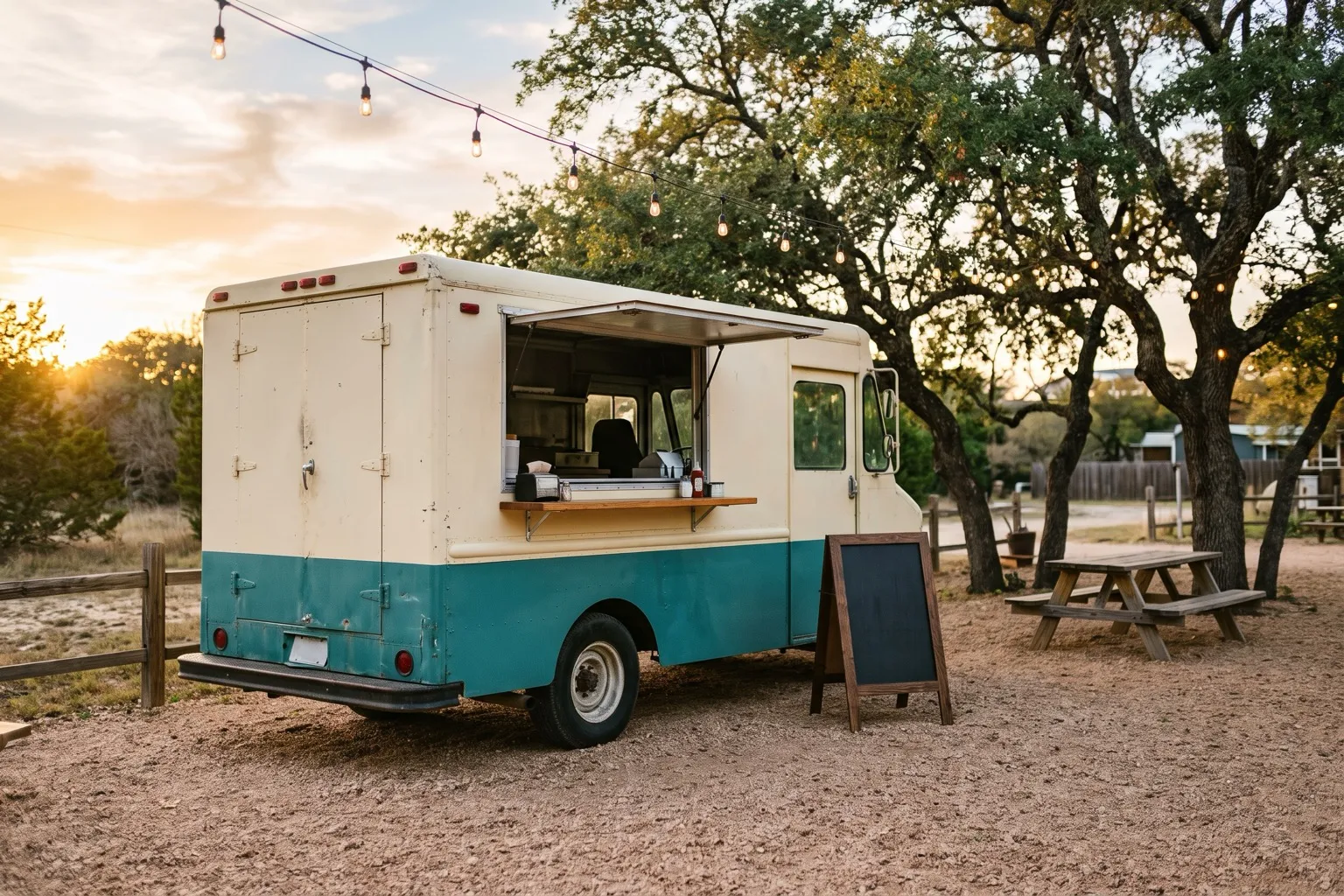
A Texas food truck used to get its permit from a city or county health department, and each city wrote its own rules. Since July 1, 2026, the state does it. This guide quotes the state law and the mobile food sections of five big city codes, as of October 2026, then covers what a certificate of insurance is and who asks a food truck for one. I am a landlord and a cost estimator, not an agent or an attorney. This guide reports what the rules say. It does not tell you what to buy.
Want a licensed Texas agent to call you?
Leave your name and number. We pass your request to one licensed Texas insurance agency, and that agency calls you back. PolicyCompared does not sell insurance.
The state license
House Bill 2844 of the 2025 session created a state license for mobile food vendors. The Texas Department of State Health Services (DSHS) mobile food vendor page describes the change:
Beginning July 1, 2026, all MFVs must be licensed with the Texas Department of State Health Services (DSHS) to operate an FVV in the state of Texas. Previously, MFVs had to get licenses from local health departments for each local jurisdiction they operated in.
MFV there means mobile food vendor, and FVV means food vending vehicle. The statute is Chapter 437B of the Health and Safety Code, added by House Bill 2844 as enrolled. Section 437B.053 lists what an applicant submits. Subsection (a)(6) is the one that mentions insurance:
(6) for each motorized food vending vehicle the applicant is applying for a license to operate: (A) the vehicle license number, description, identification number, and registration; (B) proof of vehicle insurance; and (C) a copy or proof of any additional commercial vehicle licenses or permits required by this state.
The text says “proof of vehicle insurance.” It does not say what kind of policy or how much. I did not find a dollar amount for a food truck in the statute or on the DSHS page.
The statute also limits what a city can add. Section 437B.003 reads:
This chapter preempts a local authority’s power to prohibit or regulate mobile food vendors in a manner that conflicts with this chapter.
Section 437B.002 says the chapter may not be read to require a city to change its existing program, “provided the local authority’s regulations do not conflict with this chapter.” How far that reaches into a city’s insurance rules is a legal question. Ask a licensed agent or an attorney.
Austin
The City of Austin’s mobile food vendor page says:
Beginning July 1, 2026, mobile food vendors must hold a valid state Mobile Food Vending Permit issued by DSHS. Vendors may not operate without a state permit.
Austin’s code still has a mobile food section. Chapter 10-3 of the City Code, Food and Food Handlers, is where I looked, in the version Municode listed as current on August 26, 2026. Section 10-3-91(A) says what a permit application includes. The items include:
(1) name and address of the applicant and the applicant’s identification number as shown on a current and valid government-issued identification document that includes a photograph of the applicant; (2) type of vehicle to be used for the proposed mobile food establishment; (3) proof of sales tax and use permit; (4) an itinerary of locations where sales occur;
and
(7) a notarized statement from the owner of a central preparation facility stating the mobile food establishment uses the facility as its base of operation;
The word insurance does not appear anywhere in Chapter 10-3. The central preparation facility is the truck’s base of operation, and Austin’s application asks for a statement from its owner.
Houston
Houston’s rule is in Chapter 20, Article II of the Code of Ordinances. Section 20-37 covers mobile food unit medallions. Subsection (d) says what the application includes:
Application for a medallion shall be made electronically or on forms provided by the health officer. The application shall include, at a minimum, the applicant’s full legal name and post office address; the address of the location at which the mobile food unit is stationed when not in use; the business name and address of the commissary or other fixed food service establishment from which time/temperature controlled for safety (TCS) food supplies are obtained; the address of the servicing area; a description of the mobile food unit that includes the manufacturer’s make, model, and serial number, the vehicle’s state registration number, and the signature of the applicant.
Article II does not use the word insurance. Houston’s code amends this section as recently as August 2025, before the state license took effect, and I did not confirm whether the city has changed it since.
Dallas
Dallas has no permit rule of its own for mobile food units. Section 17-8.1 of the Dallas City Code says:
The City of Dallas does not issue permits for or conduct inspections of mobile food units. Regulatory authority for mobile food units currently resides with Dallas County Health and Human Services, or such other governmental entity as may be designated by state law.
The next section in that article, which the code at American Legal Publishing shows as current through July 2026, now reads:
SEC. 17-8.2. RESERVED. (Repealed by Ord. 33283)
That section used to carry an insurance rule. A 2023 city memo lists “Dallas City Code § 17-8.2(c)(1)(E) – insurance requirements for mobile food units” among provisions it said were preempted by state law. I did not find the earlier text of that subsection, so I cannot quote what it required.
San Antonio
San Antonio changed its code after the state law passed. Section 13-61 reads:
Mobile food establishments shall obtain permits from the Texas Department of State Health Services in accordance with the provisions of the Health and Safety Code chapter 437B. Mobile food establishments must comply with local regulations consistent with state law.
The section lists Ordinance 2026-09-03-0523, dated September 3, 2026. Chapter 13 as Municode showed it does not use the word insurance or the word liability.
Fort Worth
Fort Worth’s food rules are in Chapter 16, Health and Sanitation. Section 16-131 covers mobile food units. Subsection (c)(1) says:
All mobile food units (except catering units) and pushcarts handling TCS Foods shall operate from a central preparation facility or other fixed food service establishments that are regularly inspected by a regulatory heath agency. All mobile food units handling TCS food shall report at least once a day to their central preparation facility to clean and service the mobile unit.
I read Sections 16-111 through 16-116 on permits and Sections 16-121 through 16-135 on sanitation and certain establishments. None of them uses the word insurance. I did not read the rest of the chapter, and I did not confirm whether the DSHS license has changed which office issues Fort Worth permits.
Where the insurance requests do come from
The places a food truck parks and the events it serves set their own conditions. The Dallas Parks mobile food truck concession permit guide, a Dallas Parks document separate from the city code, lists this among the documents an applicant includes in the request:
Confirmation from an insurance agency of ability to secure the required general liability and auto liability insurance (See Attachment I). All new and renewed permits will require insurance coverage for the entire term of the Agreement.
Its terms also include a section headed Certificate of Insurance. An event is similar. The City of Georgetown’s Autumn Art Stroll food truck application on Eventeny tells vendors:
Submit a copy of your Certificate of Insurance showing proof of liability coverage by September 15, 2026
and requires that the city be listed as “additional insured” through the event dates. Each of these is a condition of one place or one event. Neither is a permit rule.
What a certificate of insurance is
A certificate of insurance, or COI, is a one-page summary of a policy, prepared by the insurer or agent and sent to whoever asked. Texas Insurance Code Section 1811.152 says what it is not:
A certificate of insurance is not a policy of insurance and does not amend, extend, or alter the coverage afforded by the referenced insurance policy.
For a food truck, the requests quoted above come from a park system and an event organizer, each by contract. A commissary or a property owner can ask on the same terms. Our guide to the certificate of insurance in Texas covers the ACORD 25 form field by field, what additional insured means, and what a COI cannot prove. Because the truck is a vehicle as well as a kitchen, see our guide to personal versus commercial auto insurance for a work truck for how auto coverage is classified.
The rules above say what is filed and who asks. They do not say what a particular truck needs. Confirm current rules with DSHS and the city you work in, and ask a licensed agent.
Want a licensed Texas agent to call you?
Leave your name and number. We pass your request to one licensed Texas insurance agency, and that agency calls you back. PolicyCompared does not sell insurance.