
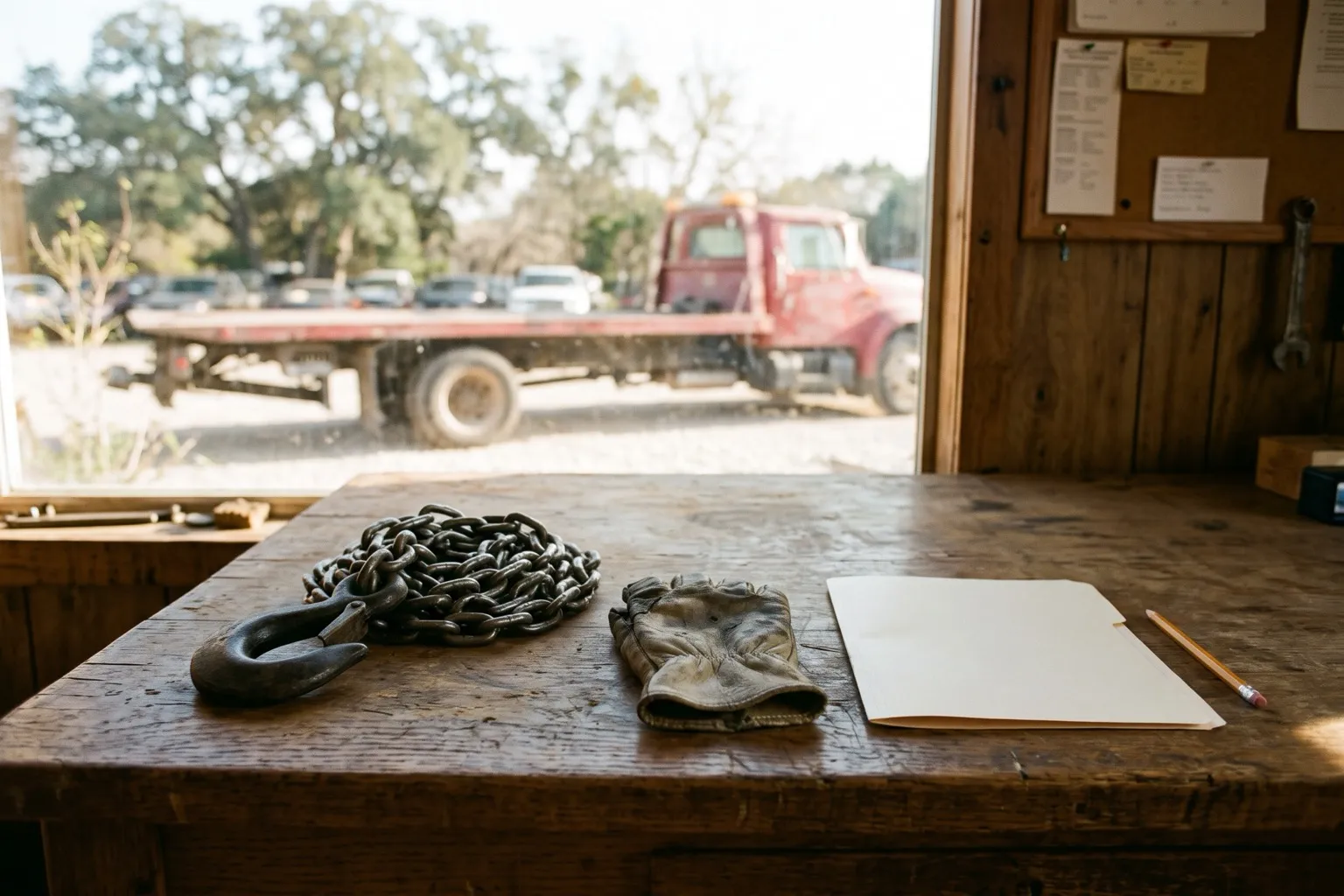
Texas has a state insurance rule for tow trucks, and it works truck by truck. A tow company files proof of insurance for each permitted truck with the Texas Department of Licensing and Regulation (TDLR), and the amount depends on the kind of towing the truck does. This guide quotes each rule as written, as of October 2026, then covers the big-city rules, what a certificate of insurance is, and who asks for one. I am a landlord and a cost estimator, not an agent or an attorney. This guide reports what the rules say. It does not tell you what to buy.
Want a licensed Texas agent to call you?
Leave your name and number. We pass your request to one licensed Texas insurance agency, and that agency calls you back. PolicyCompared does not sell insurance.
The state permit
The Texas Towing and Booting Act is Chapter 2308 of the Occupations Code. Section 2308.101 says:
A tow truck may not be used for consent towing or nonconsent towing on a public roadway in this state unless an appropriate permit has been issued for the tow truck under this subchapter. Each tow truck requires a separate permit.
Section 2308.102 says what goes in the application. Subsection (a) lists “(2) evidence of insurance or financial responsibility required under this subchapter;” among the items.
Section 2308.151 covers the company and the operator:
Unless the person holds an appropriate license under this subchapter, a person may not: (1) perform towing operations; or (2) operate a towing company.
The amounts, by permit type
Three sections set three tiers. For an incident management towing permit, the kind used for tows a peace officer initiates, Section 2308.103(b) reads:
To be eligible for an incident management towing permit, an applicant must submit evidence that: (1) the tow truck is equipped to tow light-duty or heavy-duty vehicles according to the manufacturer’s towing guidelines; (2) the applicant has at least $500,000 of liability insurance for the tow truck; and (3) the applicant has at least $50,000 of cargo insurance for the tow truck.
For a private property towing permit, the kind used when a parking facility owner authorizes a nonconsent tow, Section 2308.104(b) reads:
To be eligible for a private property towing permit, an applicant must submit evidence that: (1) the tow truck is equipped to tow light-duty or heavy-duty vehicles according to the manufacturer’s towing guidelines; (2) the applicant has at least $300,000 of liability insurance for the tow truck; and (3) the applicant has at least $50,000 of cargo insurance for the tow truck.
For a consent towing permit, the kind used when the vehicle owner summons the truck, Section 2308.105(b) reads:
To be eligible for a consent towing permit, an applicant must submit evidence that: (1) the tow truck is equipped to tow light-duty or heavy-duty vehicles according to the manufacturer’s towing guidelines; and (2) the applicant has at least $300,000 of liability insurance for the tow truck.
Those are statutory minimums for the permit. They are not a recommendation for any business.
Keeping the insurance in force
Section 2308.110, titled Financial Responsibility, reads in full:
(a) A permit holder shall maintain liability insurance for each tow truck according to the requirements under this subchapter. (b) Unless state law permits a tow truck to be self-insured, any insurance required for a tow truck must be obtained from an insurer authorized to do business in this state. (c) An applicant or permit holder must file with the department evidence of insurance as required by this subchapter. (d) A permit holder shall keep evidence of insurance in a form approved by the department in the cab of each permitted tow truck.
Section 2308.107(c) ties renewal to the same proof: a permit holder may renew by “(1) paying a fee for each tow truck; and (2) providing to the department evidence of continuing insurance or financial responsibility in an amount required by this chapter.”
What TDLR’s rule adds
16 Texas Administrative Code Section 86.400, titled Insurance Requirements for Tow Truck Permits, handles the paperwork. Subsections (a) and (b) read:
(a) An applicant for a tow truck permit is responsible for ensuring the electronic submission of a certificate of insurance when applying for an initial license or permit, submitting a license or permit renewal, changing a business name or affiliation, and upon request of the department. (b) The certificate of insurance must be obtained from and submitted by an insurance company licensed and authorized to do business in Texas pursuant to the Texas Insurance Code.
Subsection (d)(1) repeats the tiers and says how to count them:
(A) Incident Management Towing (i) a minimum of $500,000 liability insurance per tow truck per incident, which is combined single limit liability for bodily injury to or death of an individual per occurrence, loss or damage (excluding cargo) per occurrence, or both; and (ii) a minimum of $50,000 of cargo or cargo on hook insurance per tow truck per incident. (B) Private Property Towing (i) a minimum of $300,000 of liability insurance per tow truck per incident, which is combined single limit liability for bodily injury to or death of an individual per occurrence, loss or damage (excluding cargo) per occurrence, or both; and (ii) a minimum of $50,000 of cargo or cargo on hook insurance per tow truck per incident. (C) Consent Towing. A minimum of $300,000 of liability insurance per tow truck per incident, which is combined single limit liability for bodily injury to or death of an individual per occurrence, loss or damage (excluding cargo or cargo on hook) per occurrence, or both.
Subsections (d)(2) and (d)(3) add two conditions:
(2) Insurance covering permitted tow trucks must be kept in full force and effect at all times. (3) The certificate of insurance must contain a provision obligating the insurer give the department thirty days notice before the effective date of a policy cancellation date.
Subsection (e)(2) says “The department may revoke a license if the insurance has been canceled and a replacement policy has not been filed prior to the cancellation date.”
A towing company that also runs a vehicle storage facility falls under a different TDLR rule, 16 Texas Administrative Code Section 85.400, which sets its own per-claim amounts by lot size. That rule is outside this guide.
What cities can add
State law leaves room for local rules. Section 2308.208 says:
The governing body of a municipality or the commissioners court of a county may adopt an ordinance that is identical to this chapter or that imposes additional requirements that exceed the minimum standards of this chapter but may not adopt an ordinance conflicting with this chapter.
Here is what I found in each city, read on October 31, 2026.
Dallas
Dallas has two sets of wrecker rules, and both carry an insurance section. Section 48A-29 covers the vehicle tow service license, and Section 15D-46 covers emergency wreckers. Subsection (b) of Section 48A-29 includes this sentence:
The insured provisions of the policy must name the city and its officers and employees as additional insureds.
Subsections (c) and (d) of Section 48A-29 read:
(c) The automobile liability insurance must provide combined single limits of liability for bodily injury and property damage of not less than $500,000 for each occurrence, or the equivalent, for each wrecker used by the licensee. Aggregate limits of liability are prohibited. (d) The insurance for vehicles while being loaded, unloaded, or transported must provide limits of liability of not less than $25,000 for each light duty wrecker and $50,000 for each medium duty or heavy duty wrecker.
Section 15D-46 uses the same $500,000 figure in subsection (c) and words the cargo rule in subsection (d) this way:
The cargo/on hook insurance for vehicles while being loaded, unloaded, or transported must provide limits of liability of not less than $25,000 for each light duty wrecker or tilt bed/roll back carrier and $50,000 for each medium duty wrecker, heavy duty wrecker, or lowboy unit.
The publisher of the Dallas code, American Legal Publishing, notes that its posted version may not reflect the most current legislation. Read the supplement date on the page.
Houston
Houston ties its private property registration to the state rule. Section 8-111(c) reads:
Application for city registration. A tow operator may apply to the police department for registration of an auto wrecker by i) submitting a completed application on a form promulgated by the police chief; ii) paying the fee stated for this provision in the city fee schedule per auto wrecker to the police department; iii) providing verification that the auto wrecker is equipped to tow light-duty or heavy-duty motor vehicles according to the manufacturer’s guidelines; and (iv) providing proof of insurance that meets the requirements of § 86.400 of Title 16 of the Texas Administrative Code.
For police-authorized tows, Section 8-126(e)(2) leaves the numbers to the police chief:
The PATSA shall include a clause setting forth the operator’s obligation to obtain and maintain required insurance coverages and minimum insurance amounts in effect during the term of the agreement. The required insurance coverages and minimum insurance amounts shall be determined by the police chief in consultation with the director of the department of administration and regulatory affairs.
PATSA is the police-authorized tow service agreement. I did not read the current agreement form, so I am not stating its amounts.
Austin
Austin’s towing chapter is Chapter 13-6. It names no insurance dollar amount. Section 13-6-1(B) tells the police chief what the administrative rules must accomplish, including that:
towing companies and tow truck drivers are able to perform their responsibilities under this chapter and carry adequate liability insurance;
Section 13-6-7(A) says “A towing company shall comply with all applicable state laws related to towing.” I did not read the police chief’s rules adopted under Section 13-6-1(B), so I cannot say what they set.
Fort Worth
Fort Worth points to the state. Section 34-194(a) reads in part:
All individuals and entities engaged in the tow truck business within the City of Fort Worth shall at all times comply with all laws, rules, and regulations pertaining to towing operations, insurance requirements, and minimum safety standards as adopted and amended from time to time by the State of Texas, regarding the operation of tow trucks for nonconsent tows.
San Antonio
I could not confirm a San Antonio towing insurance rule. The code search I used for San Antonio indexed only its Unified Development Code, which is the zoning and building chapter, and returned nothing on tow insurance. That is a gap in my search, not a finding about the city. Check the city’s code of ordinances directly.
What a certificate of insurance is
A certificate of insurance, or COI, is a summary of your policies that your agent prepares and sends to whoever asked. The Texas Insurance Code, in Section 1811.152, says a certificate is not a policy and does not amend, extend, or alter the coverage of the policy it references. Our guide to the certificate of insurance for Texas contractors shows the form field by field.
For a tow truck the certificate is also a filing. Rule 86.400 requires it to be submitted electronically to TDLR by the insurer, and Section 2308.110(d) puts a copy in the cab.
Who asks a new towing business for one
TDLR asks first, at the permit application and every renewal. A city that licenses or registers wreckers can ask next. Houston’s code asks for proof of insurance at wrecker registration, and Dallas requires its licensed wreckers to carry the coverage quoted above.
Customers ask too. A private property tow is authorized by a parking facility owner, and a property manager who hires a vendor usually wants proof of coverage on file before the first tow. That request comes from the contract, not the statute. If the truck is also a work truck for another business, see our guide to personal versus commercial auto insurance for a work truck. For the other Texas trades with a stated rule, read which Texas trades must carry liability insurance by law.
Want a licensed Texas agent to call you?
Leave your name and number. We pass your request to one licensed Texas insurance agency, and that agency calls you back. PolicyCompared does not sell insurance.