
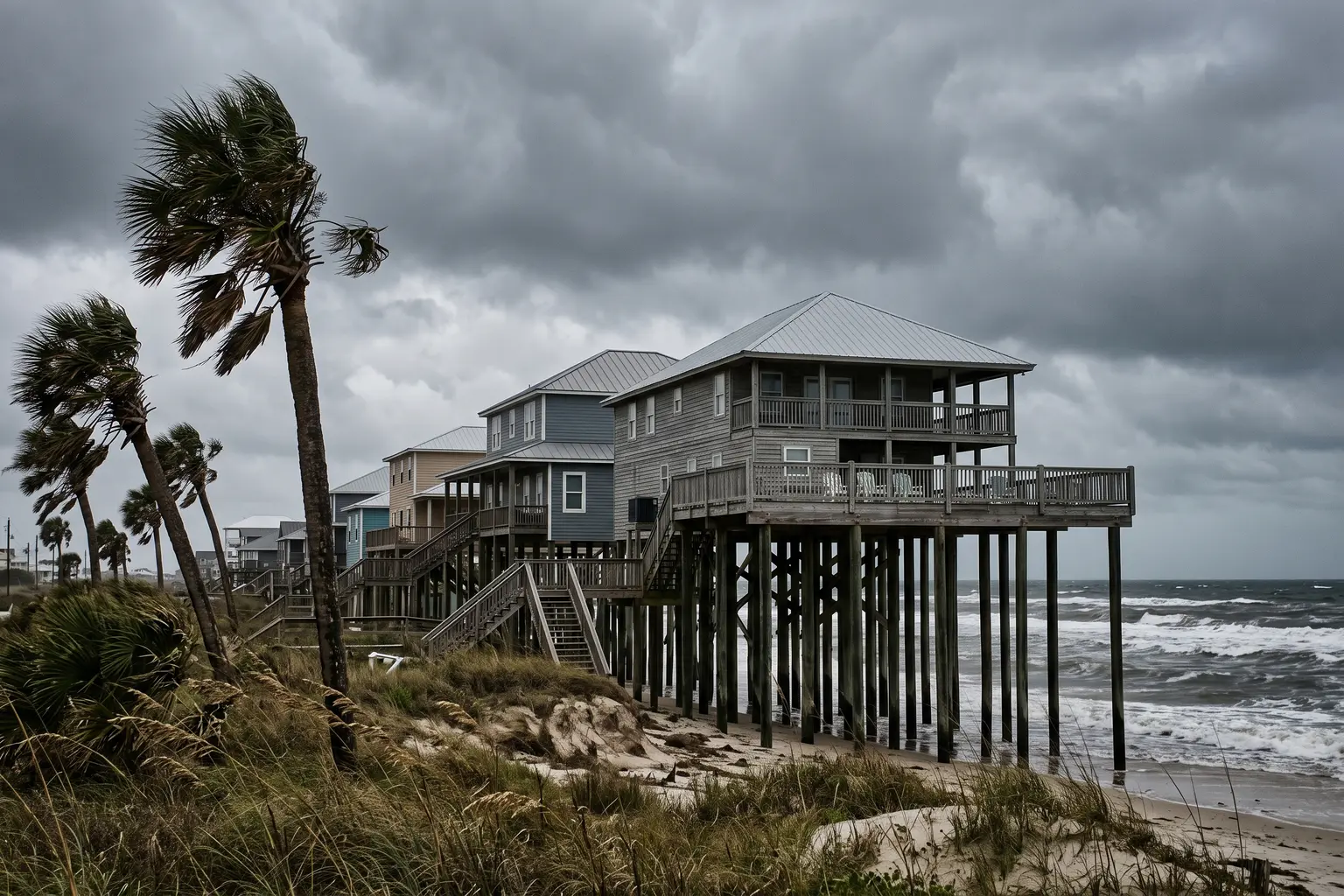
If you own a home in Galveston, Port Aransas, or Corpus Christi, someone has probably told you that TWIA is your only option for windstorm coverage. That was close to true for years. It is less true now — private carriers write wind on the coast through the voluntary market, through surplus lines, and through TWIA’s own depopulation program, which exists specifically to move policies back to private paper.
But the market share numbers say TWIA still carries most of the coast. This comparison lays out how each option works, what each costs and covers, and the specific situations where a private policy beats the state association — with everything date-stamped, because coastal insurance facts have a short shelf life.
How the coastal wind market is structured
The Texas Windstorm Insurance Association is a state-created insurer of last resort that sells wind and hail coverage only. Its territory is the 14 first-tier coastal counties plus the parts of Harris County east of State Highway 146 that sit inside the city limits of Pasadena, Morgan’s Point, Shoreacres, Seabrook, and La Porte. A TWIA policy covers wind and hail and nothing else — no fire, no theft, no water damage from plumbing, and no flood or storm surge.
That is why a coastal homeowner typically carries a stack of policies: a homeowners policy that excludes wind, a wind policy (TWIA or private), and a separate flood policy. Our guide to how wind and hail deductibles work in Texas covers the deductible mechanics that apply across that stack.
One point of frequent confusion: TWIA is not the Texas FAIR Plan. The FAIR Plan is a separate last-resort program selling basic homeowners coverage statewide. TWIA sells wind only, on the coast only. A Galveston owner declined by private carriers on both fronts can end up with a FAIR Plan policy, a TWIA policy, and a flood policy — three last-resort or federal programs stapled together.
The scale of TWIA’s role is documented in the Texas Department of Insurance’s June 2026 overview of the association. As of March 31, 2026, TWIA had 286,251 policies in force — 276,457 of them residential — and $127.1 billion in direct liability. Measured by insured residential exposure, TWIA’s share of the wind market across the catastrophe area was 55% in 2025, up from 47% in 2023. In Galveston County it was 75%. In Aransas County, home to Rockport, it was 82%. In Nueces County, which includes Corpus Christi and Port Aransas, it was 54%. On much of the coast, TWIA is not the fallback. It is the market.
What it takes to qualify for TWIA
TWIA eligibility has real requirements, and they cut both ways in this comparison. Per TDI’s overview, an applicant must have all of the following, as of August 2026:
- A declination. You must have been declined by at least one licensed insurer writing windstorm coverage in the first-tier coastal counties. An offer that is not substantially equivalent to TWIA’s coverage also counts as a declination.
- Windstorm certification. Structures built, altered, remodeled, enlarged, or repaired on or after January 1, 1988 need a certificate of compliance — the WPI-8, WPI-8-E, or the TWIA-issued WPI-8-C — showing the work met the windstorm building code. TDI has issued all certificates since June 1, 2020.
- Flood insurance, in some zones. If the structure was built or altered on or after September 1, 2009 and sits in flood Zone V, VE, or V1–V30, you must show proof of flood insurance if it is available through the National Flood Insurance Program.
- Insurable condition. The property must be in good repair, and TWIA requires evidence of repairs after it pays a claim.
The WPI-8 requirement is the one that traps buyers. A beach house with an uncertified 2015 roof replacement is not TWIA-eligible until the certification problem is resolved, and private carriers looking at the same roof often reach the same conclusion.
What TWIA costs and what it caps
TWIA reports an average residential premium of approximately $2,541 as of June 30, 2026, and its filed rate changes were 0% for residential policies in both 2025 and 2026. Against the statewide premiums in our Texas homeowners insurance cost guide, that buys wind and hail only — it is a second premium on top of your ex-wind homeowners policy.
The limits are the harder constraint. Effective January 1, 2026, TWIA’s maximum dwelling limit is $1,773,000, set by statute and adjusted for inflation annually. Contents coverage for apartments, condos, and townhouses caps at $374,000, and commercial risks at $4,424,000. A coastal home that would cost more than $1,773,000 to rebuild cannot be fully covered by TWIA at any price.
Residential deductible options run from flat $100 and $250 deductibles through 1%, with optional larger deductibles of 1.5% to 5% available for premium credits. TWIA says the deductible choice is the biggest single lever on the premium.
The two doors into private wind
Door one: the voluntary and surplus lines market. Some admitted carriers write wind on the coast directly, either as wind-only policies or folded into a full homeowners policy. USAA appears on TWIA’s own list of voluntary market depopulation participants. SageSure, a coastal-focused managing general underwriter, currently markets a wind-only product (HWO) in Texas alongside its homeowners policies. And since the Legislature passed HB 1940, eligible surplus lines insurers may write windstorm and hail coverage regardless of whether TWIA coverage is available — which opened the coast to non-admitted capacity, typically for harder-to-place or higher-value homes. Availability is carrier-by-carrier and address-by-address, which is why coastal agents earn their keep.
Door two: depopulation. TWIA runs an annual Assumption Reinsurance Depopulation Program — Round 10 covers 2026–2027 — in which participating insurers make offers on blocks of TWIA policies. If your policy is selected, you get notice around December 1 and can accept or decline through January 31, with policies transferring on March 1 (Source). Assuming carriers must offer rates and coverage comparable to TWIA’s for three renewals, and you keep your agent. Past assumption rounds have included carriers such as SafePoint, Weston Property & Casualty, Maison, United Property & Casualty, and The Woodlands Insurance Company, per TWIA’s participating companies list — a roster that has changed round to round, which is itself worth noting when you evaluate an offer.
When private beats TWIA
The honest answer is that this comparison is decided home by home, but the pattern is consistent.
Private wins on limits. If your rebuild cost exceeds $1,773,000, TWIA cannot fully cover you as of 2026. High-value coastal homes belong in the private or surplus lines market almost by default.
Private wins on simplicity. A single homeowners policy that includes wind means one carrier, one deductible structure, and no gap-hunting between an ex-wind policy and a wind-only policy. Two policies from two carriers can disagree about whether wind or water did the damage; one policy cannot argue with itself about wind versus fire.
Private can win on coverage breadth. TWIA sells a fixed product. Private carriers can offer replacement cost provisions, higher contents limits, and endorsements TWIA does not file.
TWIA wins on availability. It cannot non-renew you to manage hurricane exposure the way a private carrier can. The market share trend — 47% to 55% of coastal residential wind exposure between 2023 and 2025 — reflects private appetite retreating, and some past depopulation participants are no longer writing. Guaranteed access matters on a barrier island.
TWIA often wins on price. Flat 0% rate changes in 2025 and 2026 while private coastal pricing moved has kept TWIA competitive for ordinary homes. Compare actual quotes, not reputations.
The rental-property wrinkle
Galveston, Port Aransas, and Corpus Christi are three of the biggest short-term rental markets in Texas, and wind coverage is frequently the largest single insurance line on a coastal rental. The comparison points above all apply, with two additions. First, run the deductible math against your revenue: a 2% deductible on a $600,000 dwelling limit is $12,000 out of pocket per storm, before you account for the booking season a September claim can wipe out. Second, if you buy private coverage, confirm the policy is written for short-term rental use and ask specifically about loss of rental income coverage — a wind-only policy on either paper is not, by itself, income protection. A cheaper wind premium that leaves the rental use undisclosed is not a bargain; it is a denied claim waiting for a hurricane.
How to run the decision
Get a private quote first — you need the attempt anyway, because a declination is a TWIA eligibility requirement. If a private carrier offers coverage substantially equivalent to TWIA’s, compare limits, deductibles, roof settlement terms, and premium directly. If you are already on TWIA and a depopulation offer arrives in December, you have until January 31 to decide, the coverage must be comparable for three renewals, and staying put is always allowed. Either way, the wind policy is one layer of a stack — check it against your ex-wind homeowners policy and your flood coverage so the three meet at the edges instead of leaving a seam over your roof.