
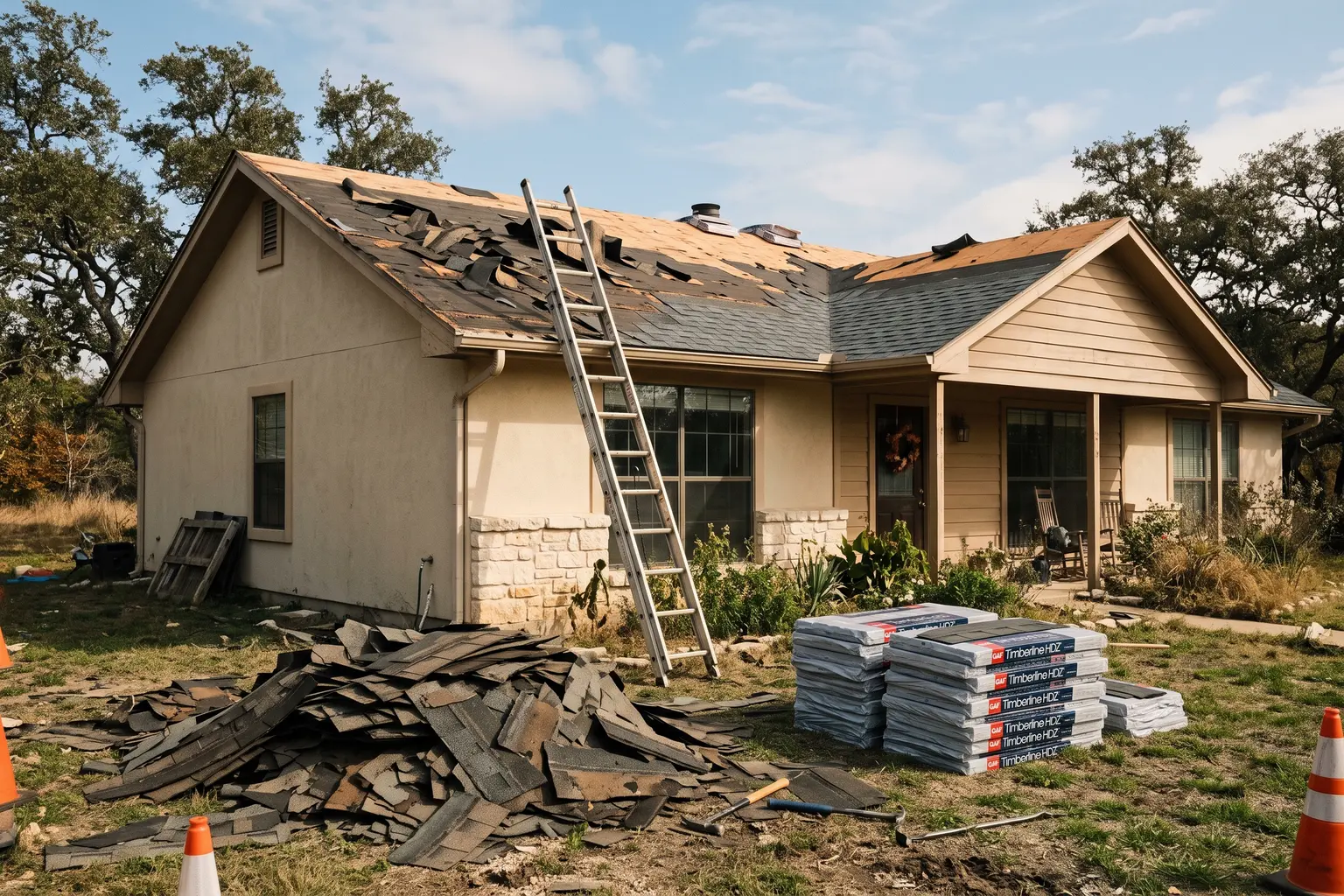
There are two numbers a Texas hail claim can settle at, and the gap between them is often larger than the deductible you spent so much time choosing. One number is what a new roof costs. The other is what your aging roof was theoretically worth the moment before the hail hit. Which number you get depends on a clause most homeowners have never read, frequently added by endorsement at a renewal they did not study. This guide explains the clause, walks the math in exact dollars, and shows where to find it on your own policy.
Two ways to settle the same roof claim
The Texas Department of Insurance defines the difference plainly in its home insurance guide. A replacement cost policy “would pay for a new roof at today’s prices.” Actual cash value is replacement cost minus depreciation, where depreciation is “a decrease in value because of wear and age.”
TDI’s guide runs the numbers on a 10-year-old roof that costs $10,000 to replace. Under replacement cost with a $2,000 deductible, the company pays $8,000. Under actual cash value, the same roof “might be $7,000. After your $2,000 deductible, your company would pay $5,000. You’d have to pay the rest of the cost of the new roof yourself.”
That is a 37.5% smaller check on a modest example. As the roof gets older and the deductible gets bigger, the gap widens fast, because both cuts come out of your side of the settlement.
The important structural point: an ACV roof provision usually does not mean your whole policy is ACV. Carriers attach an endorsement that changes loss settlement for roof surfacing only, often only for wind and hail losses, while the rest of the dwelling stays on replacement cost. Insurance brokerage Latent Insurance reports that Texas carriers commonly convert roof settlement from replacement cost to actual cash value once the roof passes a stated age, typically between 10 and 15 years depending on carrier and material. As of August 2026, that age-triggered conversion is standard practice across the Texas market, not an exotic term buried in surplus lines policies.
How the depreciation math actually works
Depreciation on a roof is usually calculated straight-line: the roof’s replacement cost divided by its expected useful life, multiplied by its age. United Policyholders, the consumer advocacy group, illustrates it with a $20,000 roof depreciating $1,000 per year. At year 10, the carrier deducts $10,000 of depreciation. Under ACV coverage with a $1,000 deductible, that homeowner is out of pocket $11,000 on a $20,000 roof. Under replacement cost, the out-of-pocket is the $1,000 deductible.
Two things about that calculation are worth knowing before an adjuster runs it on your roof.
First, the useful-life assumption drives everything, and it is an input someone chooses. A 12-year-old roof depreciated against a 30-year life loses 40% of its value. The same roof depreciated against a 20-year life loses 60%. United Policyholders’ consistent advice is that depreciation is subjective and negotiable, and that policyholders can contest an excessive figure.
Second, Texas puts a floor under the calculation. In Commissioner’s Bulletin B-0068-08, issued September 29, 2008, TDI stated that when calculating actual cash value, “the deduction of prospective contractors’ overhead and profit and sales tax, in addition to depreciation… is an improper claim settlement practice.” Depreciation for age and wear is allowed. Stripping out the contractor’s overhead, profit, and sales tax on top of it is not. Check the ACV worksheet on any Texas claim for those line items.
The worked example: what a hail claim pays on each settlement type
Now put the pieces together on a realistic Texas claim, with every step shown. Assume a home insured for $400,000 (Coverage A) with a 2% wind and hail deductible, and a carrier estimate of $30,000 to replace the hail-destroyed roof. The roof is 12 years old, and the adjuster depreciates it against a 25-year useful life. These are illustration inputs, not market averages; swap in your own numbers.
The deductible first. As we covered in our guide to Texas wind and hail deductibles, the percentage applies to the Coverage A limit, not the claim: 2% of $400,000 is $8,000, regardless of what the roof costs.
Replacement cost settlement:
- Roof replacement cost: $30,000
- Minus deductible: $8,000
- Claim payment: $22,000
(Part of that arrives as recoverable depreciation, released after you replace the roof and submit proof.)
Actual cash value settlement:
- Annual depreciation: $30,000 ÷ 25 years = $1,200 per year
- Depreciation at age 12: $1,200 × 12 = $14,400 (48% of the roof’s value, gone)
- Actual cash value: $30,000 − $14,400 = $15,600
- Minus deductible: $8,000
- Claim payment: $7,600
Same storm, same roof, same deductible. The ACV settlement pays $14,400 less, which is exactly the depreciation, and none of it is recoverable. The homeowner’s check shrinks from $22,000 to $7,600, a reduction of about 65%, while the out-of-pocket cost of getting a new roof on the house rises from $8,000 to $22,400. This is how the deductible and the depreciation stack: the deductible takes a fixed slice off the top, depreciation takes a growing slice off what remains, and both slices are yours.
Roof payment schedules are the same cut in table form
Some carriers skip the adjuster’s depreciation worksheet and file the cut as a printed table instead. A roof payment schedule endorsement pays a stated percentage of replacement cost that declines with the roof’s age and material. Homeowners of America Insurance Company’s Texas underwriting guidelines, for example, describe a Roof Systems Payment Schedule Endorsement (forms HOA.HO3.RSP and HOA.HOB.RSP) that “revises loss settlement provisions to pay a percentage of the cost to repair or replace” the roof based on a depreciation schedule.
The percentages are carrier-specific and live in the endorsement itself. One Texas agency, Gilded Oak Insurance, illustrates a schedule paying 60% on a 12-year-old roof. Run that through our example: 60% of $30,000 is $18,000, minus the $8,000 deductible, for a $10,000 payment, about 55% below the replacement cost settlement. Different mechanism than adjuster-calculated ACV, same family of outcome. The only way to know your own percentages is to read the schedule attached to your policy.
Where the clause hides on your declarations page
The declarations page itself rarely says “your roof is on ACV” in plain words. Look in three places.
First, the loss settlement or coverage summary section. If it lists separate settlement provisions for “roof surfacing” or “roof systems,” read them.
Second, the list of endorsements by form number, usually near the bottom of the declarations page. Titles to look for: anything containing “roof surfaces,” “roof systems,” “actual cash value,” “payment schedule,” or “windstorm or hail losses to roof surfacing.” If a form number looks opaque, search the form number itself in your full policy packet; the endorsement text must be in there.
Third, the renewal packet. Carriers add these endorsements at renewal as the roof ages past their threshold, and United Policyholders specifically urges homeowners to review renewal documents for coverage changes rather than assuming the policy renewed as-is. The premium may barely move while the roof settlement quietly converts.
Class 4 roofs: the discount is real, the mandate is not
The counterweight to all this is the impact-resistant roof. UL Standard 2218 rates roofing materials Class 1 through Class 4 by impact resistance, with Class 4 the toughest. Texas built a discount framework for them back in 1998: TDI’s Commissioner’s Bulletin B-0035-98 established statewide reporting for hail-resistant roof premium credits keyed to UL 2218 classes.
Note where TDI’s rules actually stand now, because roofing marketing routinely gets it wrong: the credits are voluntary. Texas carriers widely offer Class 4 discounts, but each sets its own percentage and conditions, and no rule forces them to. Consumer Reports puts State Farm’s impact-resistant roof discount at up to 35% in some states; other carriers land well below that. As of August 2026, the practical rules are: the discount applies mainly to the dwelling portion of the premium, it is not applied automatically, and you need installation documentation, often TDI’s roof certification form completed by the installer, to claim it. Given where Texas premiums sit, per our breakdown of what homeowners insurance costs in Texas, a durable double-digit credit on the dwelling premium can repay the Class 4 upcharge over the roof’s life.
Ask the carrier two separate questions before installing one: what is the premium credit, and does the impact-resistant roof change how you settle my roof losses? A discount on the way in does not automatically protect you from an ACV endorsement on the way out.
What to do with this at renewal
Pull your declarations page and answer three questions. What is my wind and hail deductible in dollars (percentage times Coverage A)? Is there a roof endorsement in the form list, and what settlement does it impose at my roof’s current age? And what would my carrier pay today, on my actual roof, using the math above?
If the answer is a number like the $7,600 in our example, roof settlement terms belong on your shopping checklist next to price. Carriers differ on the age threshold, the schedule percentages, and whether a Class 4 roof buys back replacement cost treatment, and those differences are worth real money. Our guide to comparing home insurance quotes covers how to line carriers up side by side so you are comparing the settlement terms, not just the premium.