
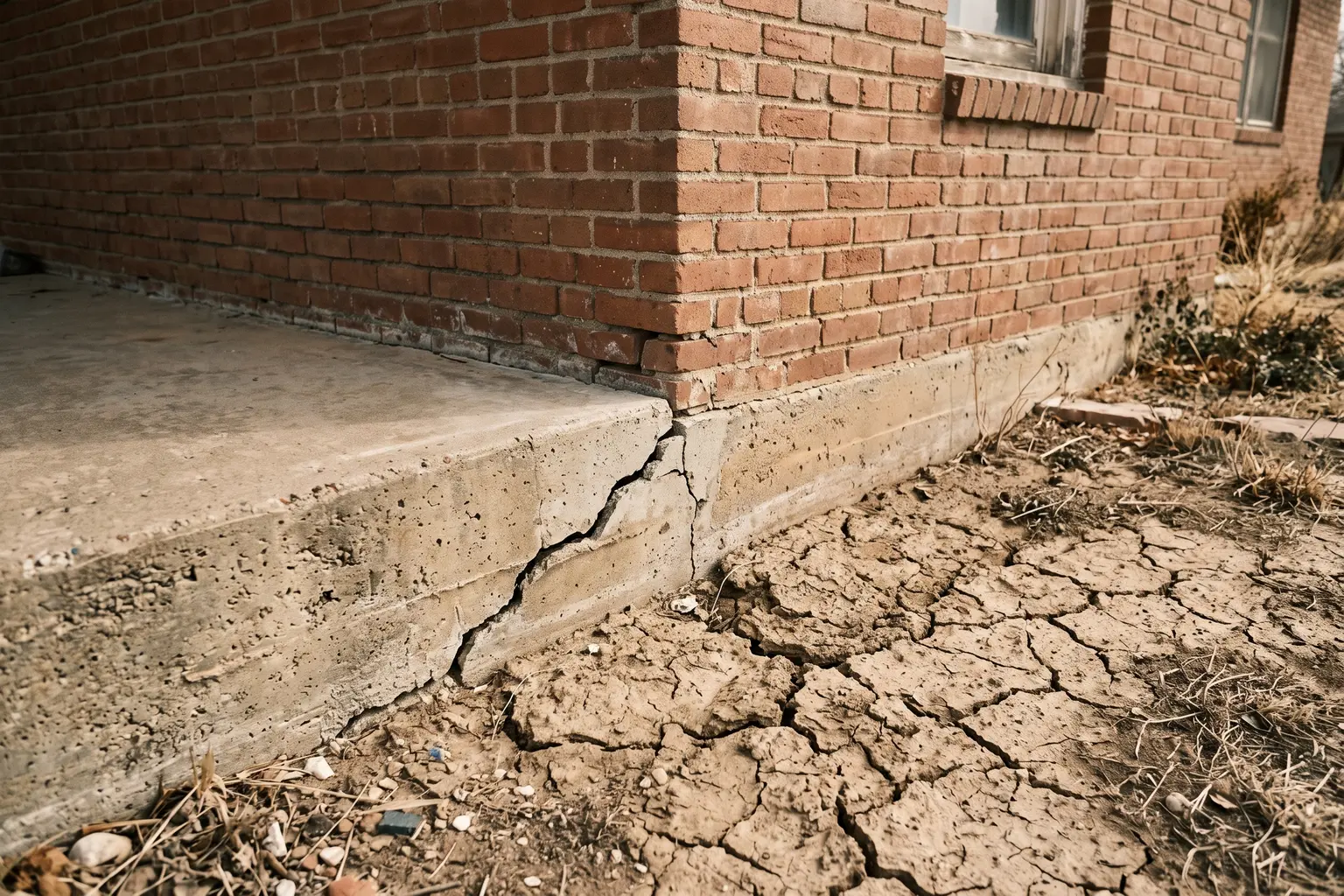
Foundation problems sit near the top of the Texas homeowner worry list for a reason. Much of the state is built on expansive clay soil that swells when it rains and shrinks in drought, flexing slab foundations up and down year after year. The insurance answer is uncomfortable: for the most common cause of foundation damage, which is soil movement and settling, homeowners insurance pays nothing. One important exception exists, and it runs through a plumbing leak under the slab. This guide covers where the line falls, which policy forms treat it differently, what the foundation endorsements sold in Texas actually add, and why the person quoting your foundation repair is the wrong person to ask about coverage.
Why Texas foundations crack in the first place
The clay belt that runs through Dallas-Fort Worth, Austin, San Antonio, and Houston contains soils that change volume dramatically with moisture. A wet spring swells the soil and lifts the slab; a summer drought shrinks it and lets the slab drop. Repeat that cycle for a decade and the concrete cracks, doors stick, and brick veneer separates at the corners.
This is not a rare event that insurance is built to absorb. It is a slow, predictable process affecting a huge share of housing stock. The American Society of Civil Engineers has estimated that expansive soils damage roughly a quarter of U.S. homes and cause more property damage in a typical year than floods, hurricanes, tornadoes, and earthquakes combined. Insurers know this, which is exactly why they wrote it out of the policy.
The exclusion that decides most claims
Every standard homeowners policy excludes earth movement. The Texas Department of Insurance’s home insurance guide lists “earthquakes or earth movement” among the things a standard policy will not cover, alongside wear and tear and continuous water leaks. Policy exclusion language typically sweeps in earth sinking, rising, and shifting, and separately excludes settling, shrinking, bulging, or expansion of foundations, walls, and floors.
That combination closes off nearly every ordinary foundation claim. The slab cracked because the clay under it dried out and dropped: excluded as earth movement. The foundation settled unevenly over fifteen years: excluded as settling. Poor drainage let water pool against the grade beam: excluded as gradual damage and, on most forms, as neglect of maintenance.
The logic follows the industry’s basic dividing line. As the Insurance Information Institute puts it, homeowners policies cover perils that are sudden and accidental; damage that develops gradually, or that results from deferred maintenance, is not what the product insures. Foundation movement from soil is the definition of gradual.
So the honest baseline answer to the title question is no. If your foundation is failing because Texas clay is doing what Texas clay does, expect to pay the repair bill yourself.
The exception: a plumbing leak under the slab
There is one scenario where the answer flips. Most Texas homes sit on slab foundations with water and drain lines running beneath or inside the concrete. When one of those lines fails, water discharges into the soil under the house, the clay swells, and the slab heaves and cracks. Now the foundation damage was not caused by weather or time. It was caused by a plumbing discharge, and accidental discharge of water from a plumbing system is a covered peril on most Texas policies.
The Texas Department of Insurance settled this question directly. In Commissioner’s Bulletin B-0032-97, issued after a court decision read the coverage narrowly, TDI stated that the HO-B form has provided, since its inception, coverage for “damage to the dwelling, including the foundation,” resulting from accidental discharge, leakage, or overflow of water from a plumbing, heating, or air conditioning system. When the leak causes settling, cracking, or bulging of the foundation, effects that would otherwise be excluded, the bulletin confirms the damage is covered because it resulted from a covered peril.
The trap in this exception is time. Policies distinguish a sudden rupture from continuous or repeated seepage, and many exclude leaks that persist over a period of weeks, commonly 14 days or more. A pipe that has been sweating into the soil for six months is a seepage claim, and seepage claims get denied. If you suspect a slab leak, an unexplained spike in the water bill, warm spots on the floor, the sound of running water with everything off, get a plumber to run a leak test immediately. That report, dating and locating the failure, is the document the entire claim rests on.
HO-B, HO-3, and HO-A treat this differently
Texas has a policy-form history most states do not, and the form on your declarations page changes the slab-leak answer. The differences are covered in depth in our HO-A vs HO-B vs HO-3 comparison, but the foundation-relevant version is short.
The Texas HO-B, the state-promulgated form most homeowners carried through the 1990s, is the most generous here: it covers sudden plumbing discharge and, on some products still sold, even continuous leakage. The HO-3, which most Texas insurers now write, covers sudden and accidental discharge but excludes gradual seepage unless an endorsement adds it back. The bare-bones HO-A, a named-perils form sold as a budget option, is the one to watch: on some products it covers no plumbing water damage at all. Homeowners of America’s published Texas product sheet shows the pattern plainly: sudden discharge covered on its HO-B and HO-3 forms, though on homes more than 20 years old that coverage comes by endorsement, and simply “not covered” on its HO-A. An HO-A holder with a slab leak may have no coverage path whatsoever.
Foundation endorsements sold in Texas
Because the base forms leave gaps, Texas insurers sell them back as add-ons. TDI’s consumer guide lists “damage to foundations or slabs” among the endorsements most companies offer.
The typical structure is a sublimit expressed as a percentage of your dwelling coverage. Homeowners of America’s Texas product is a concrete, published example: foundation or slab damage from a plumbing, heating, or AC discharge is covered at 15 percent of Coverage A, capped at $25,000, and limited to $10,000 for homes more than 35 years old. On a $400,000 dwelling limit, that is $25,000 of foundation coverage, roughly the cost of a substantial pier job. Other carriers structure it differently, and some will not offer it on older homes at all, so this is a question to put to your agent in writing before you need it. A related add-on worth asking about at the same time is service line coverage, which handles buried water and sewer lines outside the foundation, typically at limits of $10,000 or so.
Endorsement pricing is modest relative to what it buys, but it does add to a premium that is already among the nation’s highest. Our guide to what homeowners insurance costs in Texas covers the base numbers.
How a slab-leak claim actually pays
Homeowners with a confirmed slab leak are often surprised by what the check covers, so it is worth separating the three layers.
Access is covered. Standard policy language pays the cost of tearing out and replacing the part of the building necessary to reach the failed line, which is the expensive part: jackhammering the slab or tunneling beneath it can run into five figures on its own.
The resulting damage is covered. Ruined flooring, warped baseboards, wet drywall, and, where the policy or an endorsement extends to it, foundation damage the discharge caused.
The pipe itself is not covered. The same policy language that pays for tear-out excludes the system the water escaped from. The plumber’s bill for the actual line repair is yours, usually a few hundred to a couple thousand dollars, and a minor line item next to everything else.
Two practical notes. First, your deductible applies, and Texas all-other-perils deductibles are commonly 1 to 2 percent of the dwelling limit, so a small leak may not clear it. Second, adjusters scrutinize these claims for evidence the leak was long-running. Fast detection and a same-week plumber report are not just good maintenance; they are what keeps the claim on the covered side of the sudden-versus-gradual line.
The contractor conflict of interest
When cracks appear, most homeowners call a foundation repair company before they call anyone else, and then ask that company whether insurance will pay. Understand the incentive on the other side of that conversation. A contractor gets paid when you authorize a repair. Telling you insurance will never pay speeds up your out-of-pocket authorization. Telling you insurance will definitely pay helps close a bigger job. Neither statement is a coverage opinion the contractor is licensed or positioned to give, and a contractor has no visibility into your policy form, endorsements, or exclusion language.
The right sequence is the reverse. Get a licensed plumber’s hydrostatic or leak-detection test first, because the plumbing question decides the insurance question. Then read your policy or ask your agent, in writing, whether your form covers accidental discharge and whether a foundation endorsement is on the policy. Only then get repair bids, and get more than one.
The bottom line
Homeowners insurance does not cover the foundation damage most Texans actually get, which comes from expansive clay soil doing slow, excluded work. It often does cover the one scenario where a sudden plumbing leak under the slab caused the movement, and TDI has confirmed that coverage on the HO-B form reaches the foundation itself. Know which form you carry, ask whether a foundation endorsement is available before trouble starts, move fast on suspected leaks, and keep coverage questions with your agent and your policy documents rather than the contractor bidding the job. If a review turns up gaps, that is a good moment to shop your policy properly rather than renew on autopilot.