
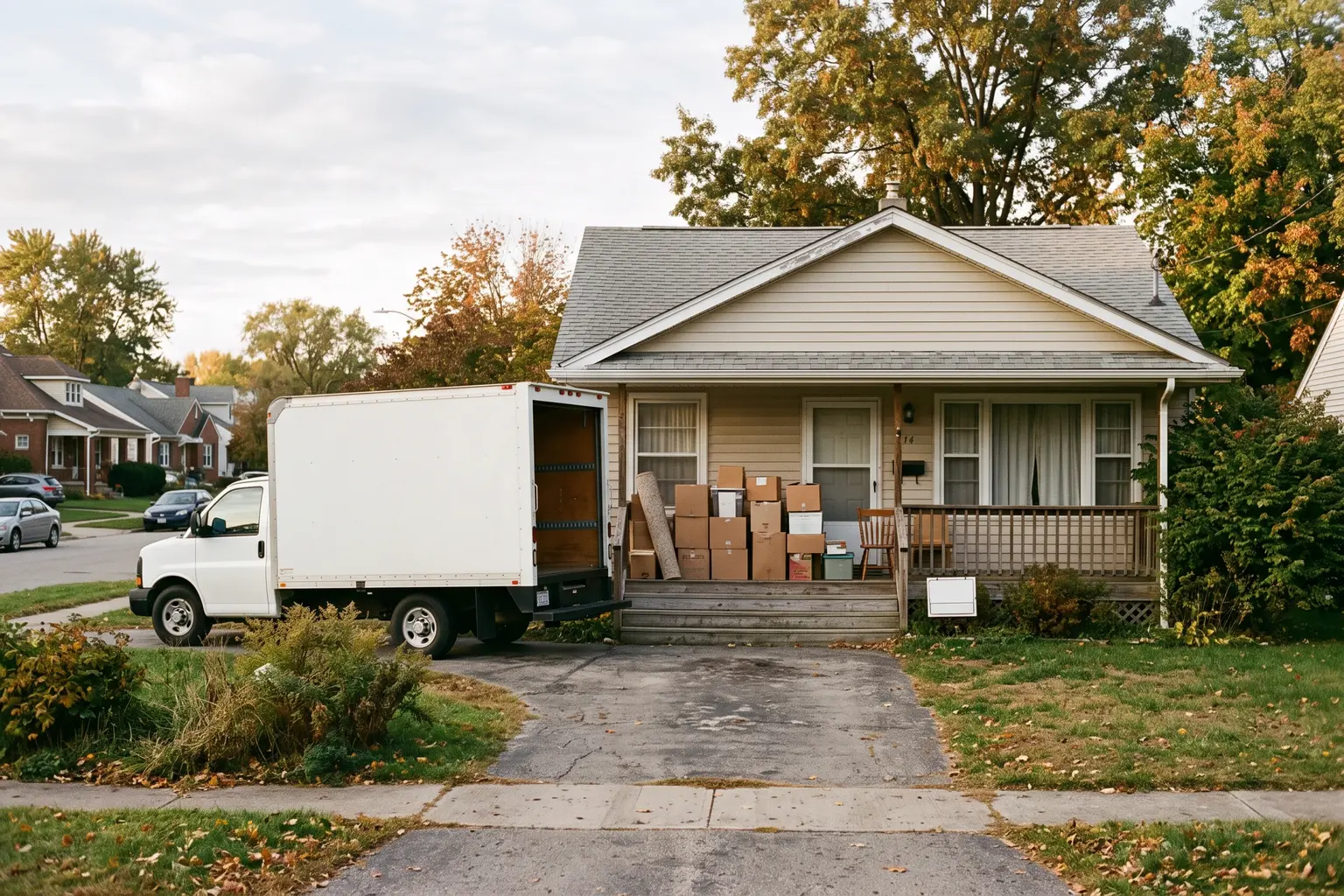
Search “fair rental value coverage” and you get a page of one-paragraph glossary entries that all say the same thing: it replaces lost rent after a covered loss. True, and useless at claim time. What decides your check is the machinery underneath — which form you have, whether the payment eats your dwelling limit, what rent figure the adjuster uses, and when the clock stops. This guide walks through that machinery and then runs one claim, dollar by dollar.
What Coverage D actually promises
On a dwelling fire policy — the DP-1, DP-2, or DP-3 form that landlord insurance is written on — lost rent lives in Coverage D, Fair Rental Value. The ISO DP-3 form (DP 00 03) states it plainly: if a loss “by a Peril Insured Against under this policy makes that part of the Described Location rented to others or held for rental by you unfit for its normal use,” the insurer covers its fair rental value, “less any expenses that do not continue” while the unit is unfit to live in.
Three phrases in that sentence carry the whole coverage.
“Peril Insured Against.” The damage must come from a peril your form covers. A kitchen fire triggers Coverage D on any form. A burst pipe triggers it on a DP-2 or DP-3 but not on a DP-1, which never covers water discharge. If the peril is not covered, the lost rent is not covered, no matter how uninhabitable the house is.
“Unfit for its normal use.” The unit has to be genuinely unusable as a dwelling, not merely damaged. A scorched detached garage does not put the tenant out. A house with no kitchen and smoke damage through the HVAC does.
“Less any expenses that do not continue.” The coverage is an income replacement, not a rent check, a distinction the International Risk Management Institute makes in defining rents and rental value insurance as time element coverage for lost rental income after covered damage. If you normally pay the water bill and the lawn service and both stop while the house sits empty, those savings come off the monthly payment.
One more line in the form matters: “held for rental by you.” A unit that is between tenants but actively on the rental market still qualifies. The coverage does not require a lease in force on the day of the fire.
Market rent, not lease rent
Fair rental value means what the space would command on the open market, not what your lease says. Policygenius describes the coverage as paying what a comparable unit would rent for, and Steadily, which writes landlord policies nationally, notes that adjusters typically start from the current lease and test it against comparable listings and local market data. The lease is evidence of market rent, not a cap on it.
This cuts both ways. A landlord charging a long-term tenant $1,850 in a neighborhood where comparable homes fetch $2,000 can recover at the market figure. A landlord whose lease is inflated above market should expect the adjuster to pay the comp-supported number, not the paper one.
How the limit works on each form
The form you carry changes both the size of the pot and, critically, whose pot it is.
| Form | Fair rental value limit | Does payment reduce Coverage A? |
|---|---|---|
| DP-1 | 20% of Coverage A, paid at up to 1/12 per month | Yes |
| DP-2 / DP-3 | 20% of Coverage A, shared with additional living expense | No |
On the DP-1 basic form, the FC&S analysis of the dwelling forms published by PropertyCasualty360 explains that fair rental value is available up to 20 percent of the Coverage A limit, paid at no more than 1/12 of that amount for each month the unit is unfit — and it is not additional insurance. Every dollar paid in lost rent reduces the Coverage A limit available for the building itself. On a total loss, using the rent coverage means shorting the rebuild.
On the current DP-2 and DP-3 forms, the same analysis notes the limit for Coverage D and Coverage E (additional living expense, which applies when the owner occupies part of the property) is 20 percent of Coverage A combined — raised from 10 percent in earlier form editions — and use of it “does not reduce the Coverage A limit of liability for the same loss.” The rent money is a separate bucket stacked on top of the dwelling limit. Older policies still on prior editions may show the 10 percent figure, which is one more reason to read the declarations page rather than assume.
The clock: shortest time to repair, not longest time empty
Coverage D does not pay until the tenant comes back. The DP-3 form pays “for the shortest time required to repair or replace” the rented portion of the property. That is a reasonableness standard: the repair period a diligent contractor needs, not the period your actual repair drags on because you took three months to pick tile. A landlord who slow-walks the rebuild is funding the extra months personally.
Two refinements in the form work in the landlord’s favor. First, the payment period “is not limited by the expiration of this policy” — if the fire happens in the last month of the policy term, the rent keeps flowing through the repair. Second, if a civil authority bars use of the property because a covered peril damaged a neighboring property, the form pays fair rental value for up to two weeks even though your building took no direct hit.
The base ISO forms contain no month cap, but many carrier versions add one. Steadily’s guidance on DP-3 policies describes coverage running for the repair period or 12 months, whichever is shorter, and 12 months is the most common cap in carrier-modified forms. If your policy has a stated time limit, it will be in the Coverage D language or the declarations, and it is worth knowing before a slab-up rebuild that takes 14 months.
What never triggers it
Every disputed loss-of-rent claim traces back to the same misunderstanding: Coverage D insures the building’s ability to be occupied, not your rental income as such.
Vacancy is not a loss. A unit that sits empty because the market is soft, the listing is overpriced, or the last tenant left produces zero coverage. There is no physical damage and no covered peril. Extended vacancy actually works against you — a home vacant long enough can void parts of the policy entirely.
A tenant who skips or stops paying is not a loss. Nonpayment, abandonment mid-lease, and eviction are credit events, not perils. The DP forms are explicit that loss “due to cancellation of a lease or agreement” is excluded. The product that covers a defaulting tenant is rent default or rent guarantee insurance, a separate specialty policy — Coverage D will never fill that gap.
Tenant damage triggers it only when the damage itself is covered. If a tenant’s negligence starts a covered fire, the resulting lost rent is covered. If the unit is unrentable because of wear, filth, or excluded intentional damage, there is no Coverage D claim — whether the underlying tenant damage is covered at all decides whether the rent loss is.
A worked claim, dollar by dollar
Assume a Texas single-family rental on a current-edition DP-3 with Coverage A of $320,000 and a $2,500 deductible. The lease rent is $1,850 per month. The landlord pays for water ($85 per month) and lawn service ($65 per month).
A kitchen fire on February 3 makes the house unfit to occupy. The tenant is released from the lease and moves out. Repairs, run diligently, take four and a half months, and the home is ready to rent again on June 18.
The rent limit available. Coverage D and E share 20 percent of Coverage A: $320,000 × 0.20 = $64,000. Because this is a DP-3, none of it comes out of the dwelling limit.
The monthly figure. Comparable homes in the neighborhood rent for $2,000, and the adjuster accepts the comps, so fair rental value is $2,000 per month — $150 more than the lease. From that, subtract the expenses that stopped while the house was empty: $85 water + $65 lawn = $150. Net fair rental value: $2,000 − $150 = $1,850 per month.
The payment period. The shortest time required to repair is 4.5 months.
The Coverage D payment. 4.5 × $1,850 = $8,325, comfortably inside the $64,000 limit.
The whole claim. The dwelling repair costs $48,500. After the $2,500 deductible, the dwelling payment is $46,000. Total claim: $46,000 + $8,325 = $54,325, and the full $320,000 Coverage A limit remains intact behind it.
Now rerun the same fire on a DP-1 with the same $320,000 limit. The rent coverage is still 20 percent, or $64,000, paid at up to 1/12 per month ($5,333.33 — more than enough for this rent). The $8,325 in rent payments goes out, but it subtracts from Coverage A, leaving $311,675 of dwelling limit for that loss. On an $8,325 rent claim that barely stings; on a 12-month total-loss rebuild it is real money missing from the reconstruction budget.
The bottom line
Fair rental value coverage pays market rent minus non-continuing expenses, for the shortest time a diligent repair requires, and only when a covered peril makes the unit unfit to occupy. On a DP-2 or DP-3 it is a separate 20 percent bucket that leaves the dwelling limit whole; on a DP-1 it drains the dwelling limit as it pays. It never covers vacancy, a tenant who quits paying, or an eviction — those need rent default coverage or a bigger reserve. Before you need it, confirm three things on your own policy: the form edition, the percentage, and whether a 12-month cap has been written in.