
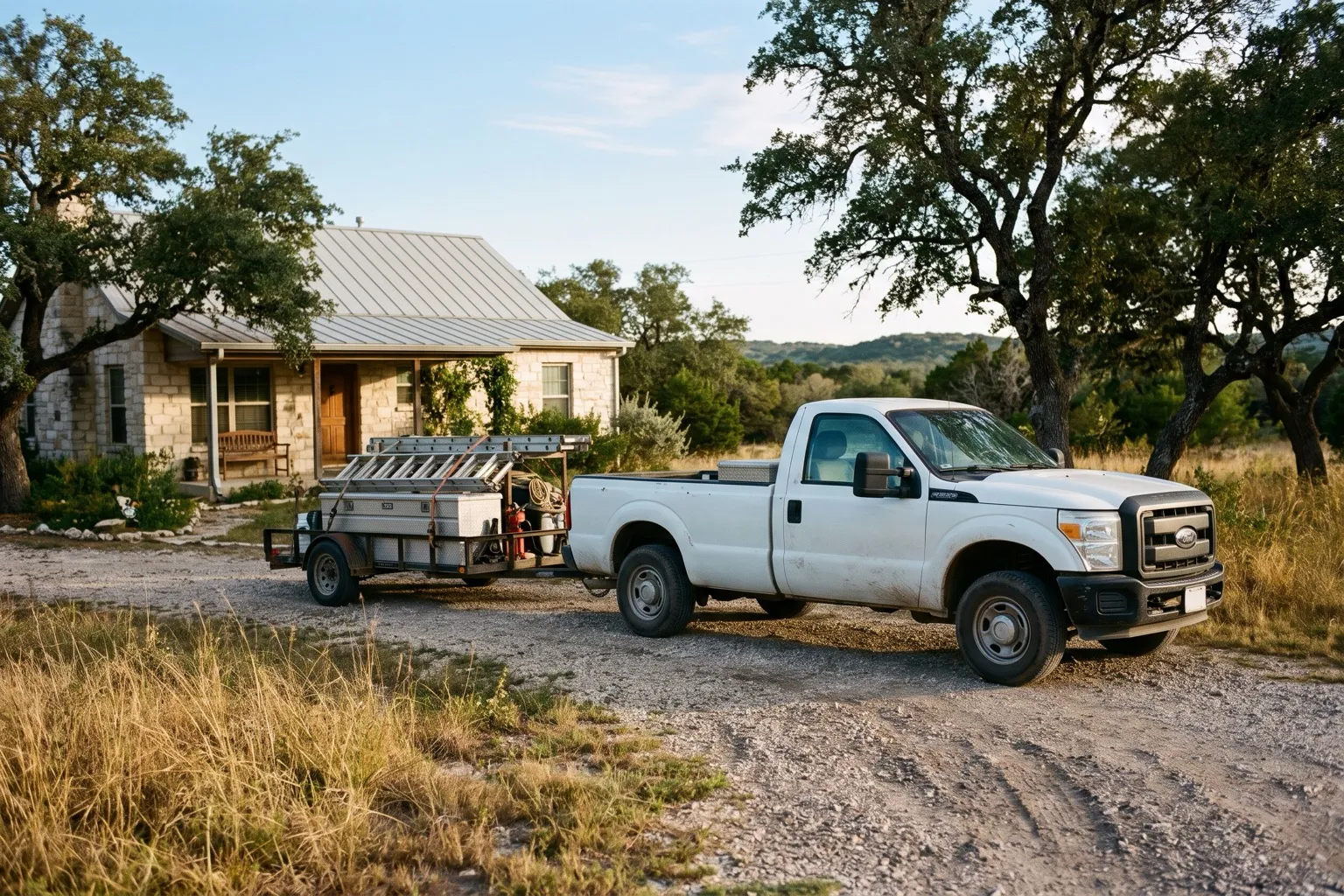
A work truck sits on the line between two kinds of insurance, and the line is drawn by wording, not by the truck. This guide reads that wording. As of October 2026, here is what a Texas personal auto policy says about business use, what the ISO business auto form changes, and where the line usually falls.
I am a landlord and a cost estimator, not an agent. I read two real forms for this guide and I quote them below. Your policy may read differently, and where it does, ask a licensed agent.
What Texas requires on any truck
The floor is the same for a family sedan and a one-ton work truck. Texas Transportation Code Section 601.072 sets the minimum liability amounts at $30,000 for bodily injury to or death of one person in one collision, $60,000 for two or more people in one collision, and $25,000 for damage to other people’s property.
The Texas Department of Insurance calls this 30/60/25 and says in its auto insurance guide that the minimum “might be too low if you cause a multi-vehicle accident or the other driver’s car is totaled.” The math is short. Say a crash puts one person in the hospital with $80,000 in bills. A 30/60/25 policy pays $30,000. The other $50,000 is the claimant’s to pursue from you.
A contractor’s truck is on job sites and highways more than a commuter car. Our umbrella policy guide reports that the Insurance Information Institute says most insurers want about $250,000 of liability on the underlying auto policy before they will sell an umbrella policy (Source). That is a floor set by insurers, not by the state.
What the personal policy says about business use
TDI’s auto guide lists what most personal policies do not cover. Two items on that list matter here: accidents “while you’re driving in Mexico, driving for business, or racing,” and accidents while “driving for a ride-hailing service or delivering food or other items for a fee.” TDI adds that rates are higher if you use your car for business. The guide says to read your policy to be sure.
So read one. I pulled a Texas Personal Auto Policy booklet from Home State County Mutual Insurance Company of Waco, administered from Irving. Personal auto wording varies by carrier, so this is one carrier’s wording, not a statewide standard. Part A, Liability Coverage, Exclusion A.7 reads:
Maintaining or using any vehicle while that person is employed or
otherwise engaged in any business or occupation not described in
Exclusion A.6. This exclusion (A.7.) does not apply to the maintenance
or use of a:
a. private passenger auto;
b. pickup or van that is your covered auto; or
c. trailer used with a vehicle described in 7.a. or 7.b. above.
Read slowly, that is a business-use exclusion with a hole cut in it. A pickup you list on the declarations page, and a trailer behind it, fall through the hole. On the base form, an owner using a listed pickup for business is not excluded by A.7.
Two other exclusions in the same form still apply to a work truck:
- Carrying property for a fee. Exclusion A.5.b removes liability while the vehicle is “being used to carry property for a fee.” It does not apply to you or a family member unless “the primary usage of the vehicle is to carry property for a fee.”
- Employee injuries. Exclusion A.4 removes liability “for bodily injury to an employee of that person during the course of employment,” except for certain domestic employees. That is a workers’ compensation question, not an auto question.
The endorsement that closes the hole
The same booklet includes an endorsement, form BU.HSCM.2022, titled Business Use Exclusion. It deletes Exclusion A.7 and replaces it with this:
Maintaining or using any vehicle for any business purpose. A business
purpose includes but is not limited to: a) transporting persons,
equipment or tools of the trade to or from a job site; or, b) using any
vehicle while employed or otherwise engaged in any business or
occupation, including but not limited to ... construction ... courier
or delivery services ... landscaping ... painting ... carpentry ...
masonry ... food services ... janitorial services ... any other
trade-type service.
It adds a matching exclusion to Part D, the coverage for damage to your own auto, and carves out “incidental business use.” The booklet does not define incidental. That word is the whole argument at claim time, and it is a question for your agent before you sign, not for the adjuster after the wreck.
The point: the same personal policy can cover a work pickup or exclude it, depending on which endorsements are attached. The declarations page and the endorsement list tell you which one you have.
What changes on a business auto form
Most commercial auto insurers in Texas use forms written by the Insurance Services Office, according to TDI’s 2024 commercial auto biennial report. Others file their own with TDI. The standard ISO form is CA 00 01, the Business Auto Coverage Form. I read the 10 13 edition. Carriers may use a later edition or a proprietary form, so treat the wording below as the model, not the contract.
The structure is different from the personal policy. A personal policy covers listed vehicles and then subtracts business use. The business auto form covers whatever the declarations designate and gives each coverage its own list.
Covered auto symbols
Item Two of the declarations assigns a numbered symbol to each coverage, and the form says those symbols “designate the only ‘autos’ that are covered ‘autos.’” The ones that matter for a small business:
| Symbol | What it covers, per CA 00 01 10 13 |
|---|---|
| 1 | Any “auto” |
| 2 | Owned “autos” only |
| 7 | Specifically described “autos,” those listed in Item Three of the declarations with a premium shown |
| 8 | Hired “autos” only, those you “lease, hire, rent or borrow” |
| 9 | Non-owned “autos” only, those you do not own, lease, hire, rent or borrow that are used in your business |
If your policy shows symbol 7 for liability, a truck missing from the schedule is not a covered auto unless the insurer already covers all your autos for that coverage or the truck replaces a covered one, and you tell the insurer within 30 days of acquiring it. The form says so in Section I.B.
Hired and non-owned autos
Symbols 8 and 9 are where a new business owner usually finds a gap. Symbol 8 picks up a truck you rent for a big job. The form excludes autos you hire from your own employees, partners or LLC members. Symbol 9 picks up an employee’s personal car or truck, “but only while used in your business or your personal affairs.”
Under TDI’s auto guide, the personal side has a matching gap. It lists accidents while “you’re driving a car that doesn’t belong to you but you could use regularly, like a company-owned car” among what most policies do not cover.
Who is an insured
Under CA 00 01, the insured is “you for any covered auto,” and “you” means the Named Insured on the declarations. If the truck is titled to an LLC and the policy names you, or the reverse, ask a licensed agent whether the owner and the insured match. The form also covers anyone using a covered auto you own, hire or borrow with your permission, with exceptions. One is an employee driving a vehicle that employee owns.
Where the line usually falls
The forms do not mention work trucks as a category. They draw the line with words like business, fee, hire and trailer. Three situations test those words most.
Towing a trailer
The Texas personal form defines a trailer as a vehicle designed to be pulled by a private passenger auto or a pickup or van. It counts “any trailer you own” as a covered auto, and its business-use exception reaches a trailer used with a covered pickup. That holds only while the base Exclusion A.7 is in place. Under the endorsement above, “equipment or tools of the trade” in the bed or on the trailer is the example of a business purpose.
On CA 00 01, trailers are handled by size. Section I.C makes trailers with a load capacity of 2,000 pounds or less automatically covered for liability. A heavier trailer is covered if it falls within the symbols entered on your declarations. Symbol 7 requires it to be listed.
Employees driving
Once someone else drives, two policies answer different questions. The personal form’s Exclusion A.7 is aimed at “that person,” the one driving, being engaged in a business. The business form asks whether the truck is a covered auto and whether the driver is an insured by permission. How a claim would play out with an employee behind the wheel of a personally insured truck depends on which A.7 you have. That is a question for your agent, with the endorsement list in front of both of you.
Logo on the truck
I searched both forms for logo, lettering, signage and advertising. Neither contains any of those words. The forms draw the line at use, not paint. In practice, a logo is evidence of use. It tells an adjuster the truck works for a business, and TDI says rates are higher when a car is used for business. Whether your carrier asks about lettering when it writes a personal policy is an underwriting question. Ask a licensed agent, and ask in writing.
Questions to put to a licensed agent
- Which version of the business-use exclusion is on my policy, and does it include the endorsement above?
- Is a truck I use to carry tools to a job site covered for liability and for damage to the truck?
- How does my carrier define incidental business use?
- If I switch to a business auto form, what symbols apply to liability, and does symbol 7 require me to list every truck and trailer?
- Do I have hired and non-owned coverage, and does it include an employee’s car on a supply run?
- Are my limits above the 30/60/25 floor, and are they enough to sit under an umbrella? The umbrella guide covers that question.
- Which carriers write a work truck, and how do the quotes compare on the same limits? Our walk-through on comparing insurance quotes is written for home policies, but the habit of lining up limits, exclusions and endorsements first transfers.
The business-activity problem shows up in rental insurance too. Our landlord insurance guide explains how standard policies treat business activity on a house, and the pattern is the same: the exclusion lives in the wording, so read the wording.
Read the form, not the brochure.